Loading...
As global energy markets navigate growing demand, energy security priorities and the transition towards lower-carbon solutions, natural gas and LNG continue to play a strategic role in the evolving energy mix. For Oman, the sector presents opportunities to strengthen energy security, attract investment and support long-term economic growth.
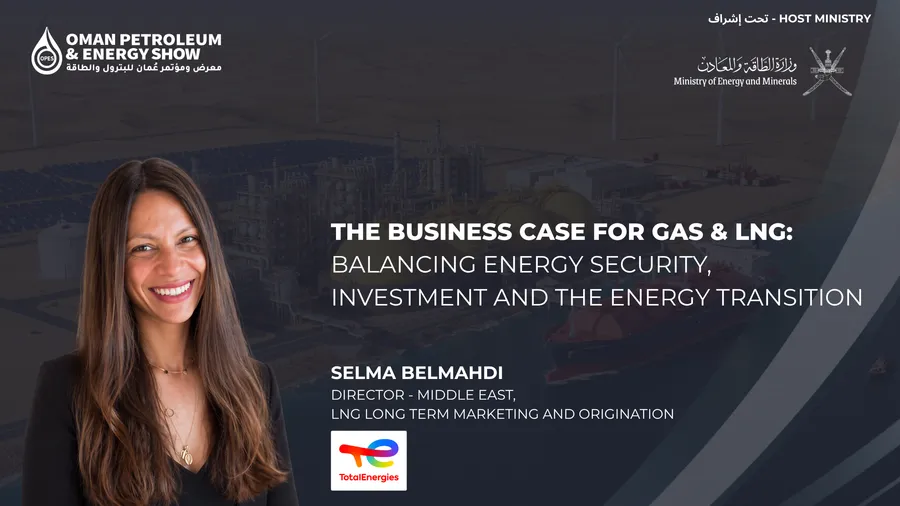
In this exclusive conversation, Selma Belmahdi, Director, Middle East, LNG Long Term Marketing and Origination, TotalEnergies shares her perspectives on the evolving business case for gas and LNG, the investment opportunities ahead and the sector’s role in balancing energy security with the global energy transition.
As global energy markets balance energy security, affordability and decarbonisation, how do you see the strategic role of natural gas and LNG evolving over the next decade?
Over the next decade, I see gas and LNG moving from a “transition fuel” to a strategic fuel. Three forces drive this. First, demand: Asia already represents more than 60% of global LNG demand, and industrialisation, electrification and now AI and data centres are adding a new layer of power demand that needs reliable, scalable supply. Second, security: the disruption around Hormuz has shown that having resources is not the same as having security of supply, so buyers now value diversification, flexibility and redundancy, moving from “just-in-time” to “just-in-case” LNG. Third, the energy mix: this is energy addition rather than substitution. Gas complements renewables with flexible, dispatchable power and, particularly in Asia, displaces coal while emitting about half as much CO₂ for the same electricity. For TotalEnergies, this is why we are growing LNG sales towards around 60 Mt/year by 2030 while continuing to reduce the carbon intensity of the chain.
With increasing competition for energy investment, what makes new gas and LNG projects commercially attractive, and which factors are most critical to ensuring their long-term viability?
New LNG projects are commercially attractive when four things come together. The first is a competitive cost position: projects on the left side of the global cost curve stay profitable through the cycle, which is the profile of TotalEnergies’ portfolio. The second is the contract structure: long-term contracts remain what underpins investment, and they are increasingly valued for security, but buyers now want them with flexibility and new pricing models. The third is integration: a player that combines upstream, liquefaction, shipping, regasification and trading reduces execution risk for buyers and monetises volumes through the cycle. The fourth is execution discipline: capex inflation is real, and waiting for costs to fall does not work, because projects die of indecision. The critical viability factors are therefore a low-cost resource, a credible carbon profile, bankable offtake, and the enabling infrastructure being in place. I would add that reliability by itself does not create value in all circumstances; it has to come with competitive terms and flexible structures.
Oman is strengthening its position in the global LNG market. What competitive advantages does the Sultanate offer international energy investors, particularly in terms of infrastructure, market access and strategic partnerships?
Oman’s strength is the combination of advantages rather than any single one. First, location: it sits on the Gulf of Oman side, and between Asian and European demand. Second, proven and reliable operations: Oman has established liquefaction capacity, a pragmatic commercial approach and long-standing relationships with buyers, and it is expanding through debottlenecking and new projects such as Marsa LNG. Third, infrastructure: ports such as Sohar, LNG bunkering potential, growing renewable power, and a shared-infrastructure mindset (power, ports, water, storage, CO₂ and potentially hydrogen) that lowers entry costs and execution risk for investors. Fourth, partnerships: a policy framework that welcomes international partners who bring customers, technology, shipping and long-term market access. Other countries may have cheaper gas or larger domestic markets, but Oman can offer reliability today, lower-carbon differentiation tomorrow, and integrated infrastructure to connect the two.
Recent geopolitical and market developments have reinforced the importance of diversified energy supplies. How can LNG contribute to greater energy security and supply resilience, particularly for fast-growing Asian markets?
LNG strengthens security and resilience in three ways. The first is diversification: no single supplier, route or project should carry the system. TotalEnergies produces LNG in eleven countries, so we have the ability to reshuffle our portfolio around for our customers. The second is flexibility: shipping capacity, regasification access and the ability to redirect cargoes between Asia and Europe let a portfolio player respond quickly to shocks. The third is contracts: long-term contracts have regained strategic value, but buyers now expect more volume, destination and seasonal flexibility. For fast-growing Asian markets, which are the main demand engine and highly exposed importers, this means diversified sources, buffers such as additional terminals and storage, and supply routes that avoid chokepoints.
As the energy industry faces increasing pressure to reduce emissions, how can gas and LNG operators improve environmental performance while maintaining operational efficiency and commercial competitiveness?
Reliability, affordability and decarbonisation have to be pursued together; the balance is engineering, portfolio management and disciplined investment, not ideology. The first lever is methane: TotalEnergies has cut methane emissions from its operated assets by 65% versus 2020 and is targeting 80% by 2030. The principle is to measure before acting, through OGMP 2.0-level 5 aligned reporting and technologies such as AUSEA drones to detect and repair leaks. The second lever is electrification and renewable power in liquefaction. The third lever is the rest of the chain: renewing the chartered carrier fleet, using LNG as a marine fuel, tackling methane slip, and over time CO₂ capture and storage. Affordability is the constraint that keeps all of this bankable: projects must stay competitive for customers, or the transition does not happen.
Through its investments and partnerships in Oman, including LNG development, how does TotalEnergies see the country's role evolving in regional and international energy markets?
TotalEnergies sees Oman as a reliable anchor for Middle East LNG and an emerging platform linking LNG, lower-carbon power and marine fuel. We are a long-standing partner in the country, including as a shareholder in Oman LNG, and our flagship project is Marsa LNG. It combines upstream gas from Block 10, an electrically driven LNG plant of about 1 Mtpa in Sohar, a dedicated solar plant of around 300 MWp, port infrastructure and LNG bunkering. Its carbon intensity is expected to be below 3 kgCO₂e/boe, against a much higher industry average. For reference, this is 90% lower than the average carbon intensity of LNG plants in the world, which stands around 35 kg CO2e/boe. It is a good example of how next-generation LNG will be designed. We see Oman’s role evolving from exporter of molecules to a broader energy and maritime services platform: a bunkering hub at the crossroads of key trade flows, and industrial clusters sharing power, port and CO₂ infrastructure. TotalEnergies brings the integrated chain that supports that: customers, shipping, trading and a global portfolio, and our ambition is to be the partner of choice.
Looking towards 2030 and beyond, what emerging technologies, investment models or market developments do you believe will most significantly influence the future competitiveness of the global gas and LNG industry?
Four developments will most shape competitiveness towards 2030 and beyond. The first is lower-carbon design and measurement. The second is commercial models: pricing structures, flexibility that is valued fairly, and integrated portfolio players offering a full supply solution rather than a standard cargo. The third is power demand: AI, data centres and electrification are increasing the need for reliable 24/7 generation, where gas and LNG complement renewables and compete mainly with coal. The fourth is infrastructure and capital: shared infrastructure, bunkering and new supply geographies, financed by a wider pool of capital, including infrastructure and investment funds. Underlying all of this, the winners will be those who are robust enough to adapt to different futures rather than betting on a single forecast.