Loading...

26 - 28 APRIL 2027
OCEC, MUSCAT
OCEC, MUSCAT
The Global Hydrogen Review 2025 underscores a defining truth: hydrogen remains central to the global energy transition, but the speed and scale of deployment hinge on investment flows and the successful integration of carbon capture, utilisation and storage (CCUS). For Oman and the Middle East—anchored by the Oman Petroleum & Energy Show (OPES) as a platform for global energy dialogue—the findings highlight both challenges and opportunities.
Hydrogen is capital intensive, and progress depends on confidence in bankable projects. According to the review, annualised spending on low-emissions hydrogen projects that had reached final investment decision (FID) by mid-2025 amounted to USD 7.9 billion, with over half directed toward existing industrial applications such as refining and ammonia.
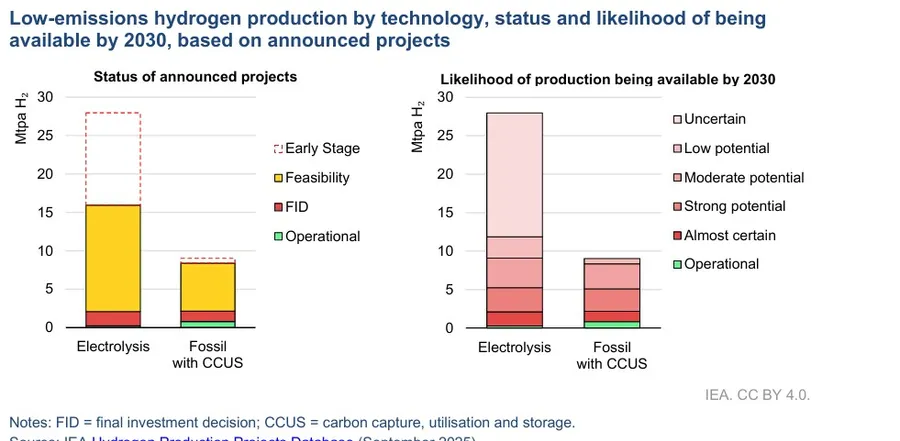
While announcements remain abundant, actual committed investment is lagging. Just 9% of the global project pipeline to 2030 has achieved FIDThis gap reflects uncertainty around demand, high costs relative to fossil-based hydrogen, and fragmented regulatory frameworks. The result is a cautious investment climate—even as the number of projects receiving FID grew nearly 20% over the past year.
For Oman, this signals the importance of creating an enabling investment ecosystem. Duqm, Sohar, and Salalah have already attracted international developers and financing institutions for hydrogen and ammonia projects. Yet, scaling further will depend on regulatory clarity, risk-sharing mechanisms, and early offtake guarantees to convince global investors.
The cost gap between fossil-based hydrogen and renewable hydrogen produced via electrolysis is a recurring barrier. Here, CCUS provides a critical bridge. The IEA highlights that in regions with low-cost natural gas, such as the Middle East, hydrogen from fossil fuels with CCUS is likely to be more competitive in the near term than electrolysis.
Globally, CCUS-based projects remain part of the hydrogen pipeline, though delays have reduced their projected contribution by 2030. Even so, committed CCUS projects represent a significant share of low-emissions hydrogen expected to come online this decade.
For Oman, this is highly relevant. With vast natural gas reserves and established processing infrastructure, Oman can leverage CCUS to decarbonise its current hydrogen production while scaling renewable hydrogen in parallel. By aligning with global CCUS best practices and accelerating pilot projects, Oman could demonstrate cost-competitive low-emissions hydrogen earlier than many markets.
Investment is not only about volume but also about risk appetite. The IEA notes that many early-stage technologies across the hydrogen value chain still struggle with bankability due to a lack of proven track record. Export credit agencies and public finance institutions are therefore recommended to expand guarantee programmes for first-of-a-kind projects.
For Oman, where sovereign investment arms such as the Oman Investment Authority (OIA) and partnerships with global funds are already active, this offers a pathway. By blending public capital with private equity and international financing instruments, Oman could derisk pioneering CCUS and hydrogen projects, catalysing faster investment decisions.
For OPES 2026, this data finds direct resonance in these insights. Hydrogen and CCUS are not standalone technologies; they are integral to the evolution of oil and gas operations.
For upstream and midstream operators, CCUS offers a pragmatic decarbonisation route that maintains competitiveness while reducing emissions intensity.
For downstream industries, including refining and petrochemicals, integrating CCUS with hydrogen production secures cleaner feedstock and positions Oman as a sustainable exporter.
For investors and policymakers, the clear message is to design frameworks that bridge the cost gap, encourage offtake agreements, and cluster hydrogen projects near industrial hubs for early adoption.
The Global Hydrogen Review 2025 makes clear that the sector is maturing, but bottlenecks persist. The winners of the hydrogen economy will be those who mobilise capital, deploy CCUS as a cost-effective transition tool, and build demand certainty through regulation and partnerships.
At OPES 2025, Oman has the opportunity to showcase how its investment climate, natural resource base, and innovation drive are converging to make low-emissions hydrogen and CCUS a foundation of its energy transition. By positioning itself as both a regional first mover and a global collaborator, Oman can ensure hydrogen and CCUS are not just technologies of the future—but engines of today’s energy transformation.
Source: Global Hydrogen Review 2025