Achieving sustainability in the energy sector is expected to lead to a net increase in jobs worldwide by 2030 compared to a business-as-usual path. This employment growth is largely due to the greater labor intensity of renewable energy production relative to fossil fuel-based power generation. However, this positive trend comes with substantial regional disparities. While regions such as the Americas, Asia, and Europe are expected to experience net job creation,Regions such as the Americas, Asia, and Europe are expected to experience net job creation, the Middle East region is working stedfast in potentially equipping and boosting
jobs in the energy sector. For MENA countries, adapting policies to encourage green transition is not just beneficial but necessary to ensure sustainable employment growth and reduce reliance on fossil fuels.
Policy interventions are thus essential to mitigate these potential job losses and address the negative impacts. For MENA countries, adapting policies to encourage green transition is not just beneficial but necessary to ensure sustainable employment growth and reduce reliance on fossil fuels.
As the global transition to green energy intensifies, developed countries have begun employing trade policies to promote decarbonization. These policies often involve imposing import taxes and export subsidies based on the carbon content of goods. For example, the European Union’s (EU) carbon border adjustment mechanism imposes tariffs on imports from countries with lower carbon taxes. Such policies aim to incentivize trading partners, especially developing countries, to raise their environmental standards, aligning them with the stricter environmental regulations of wealthier nations. This shift in trade policy is part of a broader trend in which environmental provisions (EPs) are increasingly embedded in trade agreements, requiring countries to comply with national and international environmental regulations. As environmental standards become more stringent, the cost of carbon-emitting production processes is expected to rise. Understanding the implications of rising costs associated with carbon-emitting production processes on trade flows, as well as on labor markets and employment, in developing countries is crucial. For example, the MENA region is highly vulnerable to climate change, with 60 percent of its population living in areas facing severe water stress, a situation expected to worsen. Climate change may reduce rainfed crop yields by 30 percent, threatening food security and increasing dependence on imports. Rising temperatures and sea levels also put coastal cities at risk of displacement and economic loss, while more frequent and intense climate-related disasters, such as droughts and floods, further exacerbate the region's challenges. The global shift to green energy and the pressure to reduce carbon emissions are reshaping both trade dynamics and labor markets in MENA, presenting unique opportunities and challenges
The first key question this study addresses is:
how do trade-related environmental policies impact carbon-intensive industries and trade flows, particularly in developing countries?
Early theoretical work, such as Pethig’s (1976) general equilibrium model, demonstrated that environmental regulations can shift comparative advantage between countries. This framework was extended by McGuire (1982), who integrated environmental factors into the Heckscher-Ohlin model, illustrating how countries adjust their production in response to environmental policies. Copeland and Taylor (1994) furthered this analysis by highlighting how countries might specialize in "dirty" or "clean" goods depending on the stringency of their environmental regulations, particularly in North-South trade dynamics. Grossman and Krueger (1991) provided the foundational scale, composition, and technique effects framework to understand how trade affects the environment. Despite these advances in theory, empirical literature on environmental provisions in trade agreements has found mixed repercussions. Antweiler et al. (2001) and Frankel and Rose (2005) suggested that trade could enhance environmental quality, while Cole and Elliott (2003) found the relationship to be more ambiguous, with effects varying by industry and region. More recently, Mattoo et al. (2020) demonstrated that environmental provisions in trade agreements have become more common over the past 30 years, especially in agreements involving high-income countries, where they serve as a bargaining tool to promote environmental goals.
However, Dai et al. (2021) found that stringent environmental policies had little effect on trade in environmental goods but did influence the trade of other carbon-intensive products. Similarly, Berger et al. (2020) showed that environmental provisions in preferential trade agreements (PTAs) can moderate the overall trade-boosting effect of PTAs, particularly in developing countries, where compliance costs may be higher. This paper contributes to this literature by making some of the first estimates of how trade related EPs affect carbon-intensive industries and trade flows in developing countries.
The key novelty of this study is that we assess how EPs in trade agreements affect trade flows by 3 constructing a database of trade agreements with environmental provisions. This dataset combines measures of: (i) bilateral trade flows; (ii) export and import-specific factors, as well as various trade costs; (iii) membership in RTAs; and (iv) information about the types of environmental clauses specified in the RTAs. While information on (i) and (ii) can often be found in standard databases, we build our database of environmental clauses in RTAs by analyzing each trade agreement individually from the World Trade Organization’s (WTO) RTA database.
The second key question this study addresses is: what are the labor market consequences of rising carbon prices and the transition to renewable energy, particularly for developing economies reliant on fossil fuels? Several studies have documented the employment effects of transitioning to renewable energy, particularly in developed countries.
Chan and Zhou (2023) found that the expansion of solar and wind energy in the United States (U.S) from 2005 to 2019 increased employment and wages, especially benefiting younger and lower-educated workers, while reducing reliance on government welfare programs. In Germany, Sievers et al. (2019) noted that the energy transition boosted employment, particularly in construction and electricity generation, with regions like northern and eastern Germany benefiting the most from investments in renewable energy.
However, the shift away from carbon-intensive industries poses significant challenges for regions heavily dependent on fossil fuels. Hanson (2023) emphasized the negative labor market consequences in such regions, highlighting the need for robust social safety nets and place-based policies to mitigate job losses. Baran et al. (2020) examined decarbonization in coal-dependent countries such as Poland, noting net job losses when cleaner energy sources, such as imported gas, replaced coal. Similarly, Jarvis et al. (2022) highlighted the social and environmental costs of Germany’s nuclear phase-out, which led to increased coal-fired energy production and associated public health risks, underscoring the complexity of the energy transition.
In developing countries, how rising carbon prices affect labor markets remain underexplored. For example, Casey et al. (2020) showed that state-level carbon pricing in the U.S. led to a 2.7% reduction in local employment, with neighboring states absorbing displaced workers. However, countries like Tunisia, which rely heavily on imported fossil fuels, face different challenges. Tunisia aims to increase its renewable energy capacity from 8% to 35% by 2030, which will create new job opportunities in green sectors such as solar and wind power. Yet, this shift is also likely to result in job displacement in carbon-intensive industries, such as oil and gas. As Tunisia diversifies its energy mix, understanding the labor market effects of these energy price shifts is crucial for designing policies that mitigate the negative consequences of the transition.
The study addresses this gap by examining the labor market consequences of rising carbon prices in Tunisia. By focusing on employment, we will assess how the green transition affects vulnerable labor markets. The rest of the paper is organized in the following manner.2 Section 2 on methodology discusses the econometric approaches undertaken to study the dual objectives of this paper: (i) estimate how EPs in trade agreements affect trade flows, and (ii) estimate the local labor 2Annex B provides some additional results analyzing if a carbon adjustment tariff can be effective. 4 market effects of rising carbon prices. Section 3 discusses all relevant data sources used in this paper. Section 4 provides a detailed description of the results.
Trends in Trade and Regional Agreements
It is important to start this section by indicating that our paper is different from Brandi et al. (2020) in that they focus on how environmental provisions affect green versus non-green trade flows.
The focus on the labor-market and overall trade impact of the environmental provisions. Second, to address the collinearity issue we group the provisions as well as we examine them individually. Once we get the initial negative effect, it is important to include all of them because we directly compare them with each other. To address multicollinearity, we combine different provisions, and we try to do that by grouping them into similar categories.
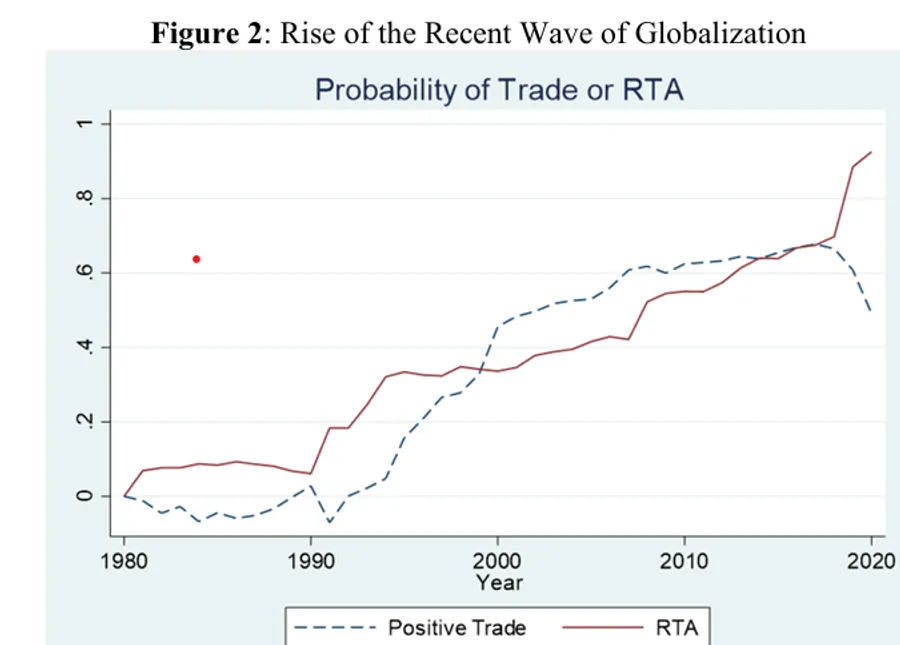
The results show that the probability of trade and having an RTA increase over time in the data. Figure 2 shows the adjusted coefficients from probit equations, with dependent variables being a dummy, indicating whether the country pair has positive trade in each year or a dummy variable indicating whether a country pair has an RTA (conditional on having positive trade). Figure 2 shows the rise of the recent wave of globalization in the 1990s as both the probability of trade (the “extensive margin” of trade) and RTAs increased. RTAs continue to become more likely as trade along the extensive margin continues to slowly rise.
MENA countries followed these global trends. Figure 3 shows that MENA countries closely follow global trends along the extensive margin. Figure 3 contains the simple average of the share of country pairs with positive trade for all country pairs in which a MENA country is an importer or exporter. Note that the COVID crisis in 2020 is evident in both the MENA and 8 global averages. MENA countries also closely follow global trends in the share of pairs with RTAs.
Source:
World Bank Document